
By Sandra Bargeron, PA-C, CAA. Founder of Beyond Brain Health™ and creator of the Neurologic Stress & Recovery Index™ (NSRI™).
Some families describe it in a single quiet sentence.
“She was never quite the same after surgery.”
The operation went well. The anesthesia record looked normal. The incision healed and the labs came back fine. But the person who came home seemed changed.
For years, that experience lived in the gap between what the charts showed and what families saw at the kitchen table. A 2026 study now puts real numbers to it.
Here is the short version. Researchers followed 560 adults aged 70 and older for up to six years after major surgery. About 1 in 7 experienced severe cognitive decline. The strongest warning signs were not hidden inside the operating room. Many were visible in the brain before surgery even began.
That last point changes everything. It means the weeks before surgery are not empty waiting time. They may be the most important window we have.
What did the 2026 SAGES study find?
The study, published by Jones and colleagues in the Journal of the American Geriatrics Society, analyzed the SAGES cohort. SAGES followed 560 older adults after major elective non-cardiac surgery and tracked their thinking and memory for up to six years.
Recovery was not one single story. People followed three different cognitive paths after surgery.

That 15% severe-decline group is the “1 in 7” figure people are discussing. It is a real and sobering number. But it is not the most useful part of the study.
The most useful part is what set that group apart.
What separated the people who declined the most?
The severe-decline group shared a pattern. They were more likely to be older. They were more likely to have lower cognitive scores before surgery. And they were more likely to experience delirium after surgery.
Postoperative delirium stood out. In this study, delirium after surgery carried more than a two-fold higher risk of landing in the severe-decline group.
In plain language: the brain that walked into surgery mattered and influenced long-term brain health.
This does not mean anesthesia is harmless, or that the type of surgery never counts. It means we have been looking mostly at the procedure, when we also need to look at the patient’s neurologic reserve before the procedure.
Why does the brain before surgery matter so much?
Surgery and anesthesia are not only body events. They are neurologic stressors.
During and after an operation, the brain absorbs a great deal at once: inflammation, disrupted sleep, pain, medication changes, shifts in blood pressure, immune activation, metabolic stress, and the confusion of an unfamiliar hospital setting.
Some brains walk in with plenty of reserve to weather that storm. Others are already running close to empty.
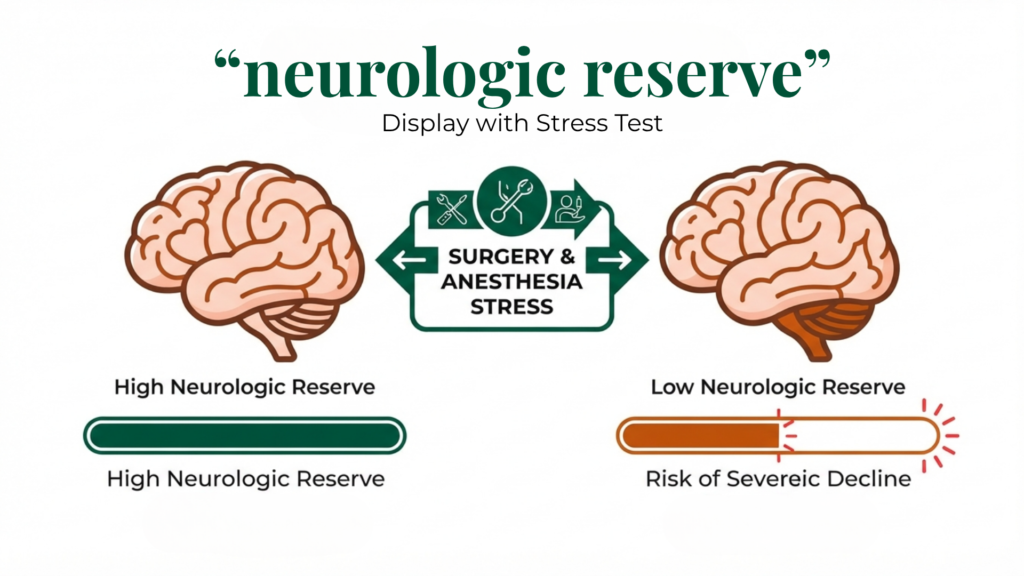
Think of it like a stress test. Two people can face the same challenge and come out very differently, depending on the reserve they brought with them. The operating room showed me this again and again over sixteen years in anesthesia. Two patients, nearly identical surgeries, the same caliber of care, and two completely different recoveries.
Is this study bad news or good news?
It is easy to read a headline like “1 in 7 decline after surgery” and feel only fear. That is the wrong takeaway.
This study is a gift, because it points to timing.
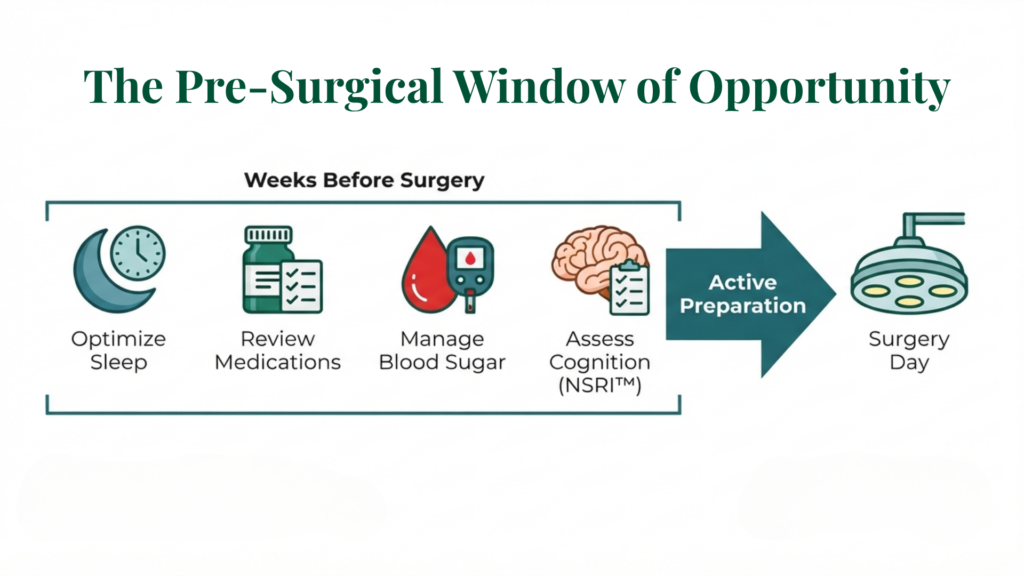
If the risk signal is already visible before surgery, then the pre-surgical window is where we can act. You cannot change a brain’s reserve during the operation. But in the weeks before, many of the factors that shape reserve can be measured, discussed, and in many cases strengthened.
The SAGES data does not promise that every case of decline is preventable. It does not say one score can predict the future. It does not say one supplement or one anesthesia technique solves the problem. It says something more practical: older adults do not all enter surgery with the same brain reserve, and delirium is not always harmless confusion. It can be a warning signal for long-term vulnerability.
What is neurologic reserve, and can it be measured?
Neurologic reserve is your brain’s ability to absorb stress and recover from it. It is shaped by things like baseline cognition, sleep, medication burden, inflammation, blood sugar control, mood, isolation, frailty, and any history of delirium.
Most of these are already tracked somewhere in a person’s health, but they are rarely pulled together into one picture before surgery.
That is the thinking behind the Neurologic Stress & Recovery Index™ (NSRI™). The NSRI™ quantifies modifiable factors that may influence how the brain absorbs and recovers from major stress, including surgery, anesthesia, illness, inflammation, sleep loss, medication load, and the demands of recovery. It does not diagnose a condition, and it does not predict any single person’s outcome. It identifies what can be strengthened before the stress test of surgery begins.
What questions should families ask before surgery?
Before an operation, the questions usually focus on the procedure:
How long will it take? What are the risks of bleeding or infection? When can they walk again? How long is the hospital stay?
Those questions matter. But for an older adult, they are incomplete. It helps to also ask:
What is the brain’s baseline right now? Has thinking or memory already changed? How is sleep? How heavy is the medication load? Is there chronic inflammation, insulin resistance, pain, depression, isolation, frailty, or a past episode of delirium? What can be strengthened before surgery day?
These questions do not blame the patient, the surgeon, or the anesthesia. They give families a framework that finally matches what they have seen, and a measure of control over the outcome.
The brain deserves its own pre-surgical conversation
As part of the operating room team, I know how well we are trained to protect the airway, blood pressure, oxygen, bleeding risk, infection risk, and immediate recovery. That training is why we can honestly tell patients their risk of a serious event during surgery is very low.
But making it through surgery safely is not the same as making it through unchanged.
Brain recovery needs its own pre-surgical lens. The next era of perioperative care cannot stop at “Is the patient cleared for surgery?” It has to also ask, “Is the brain ready for the stress of surgery?”
That question is where prevention begins.

Frequently asked questions
Does anesthesia cause dementia?
Current evidence does not show that anesthesia alone causes dementia. The 2026 SAGES study suggests the larger signals for long-term cognitive decline were present before surgery, especially older age and lower baseline cognition, along with delirium afterward. Anesthesia is one stressor among many, not a single cause.
What is postoperative delirium, and why does it matter?
Postoperative delirium is a sudden state of confusion, disorientation, or fluctuating attention that can appear in the hours or days after surgery. It is common in older adults. In the SAGES study, it carried more than a two-fold higher risk of severe long-term cognitive decline, so it deserves to be taken seriously rather than dismissed as temporary.
Can cognitive decline after surgery be prevented?
Not every case can be prevented. But because many risk factors are visible before surgery, there is often room to prepare. Measuring and strengthening modifiable factors during the pre-surgical window is where prevention efforts can begin.
What is the NSRI™?
The Neurologic Stress & Recovery Index™ (NSRI™) is a pre-surgical assessment that quantifies modifiable factors linked to neurologic reserve. It identifies what can be strengthened before major stress like surgery. It does not diagnose conditions and does not predict individual outcomes.
Who should consider a pre-surgical brain assessment?
It is most relevant for adults over 70 facing major surgery, anyone with a history of delirium, and families who want a clearer picture of brain readiness before an operation. It can also help younger patients who carry a high medication burden or chronic inflammation.
